
Epiphany
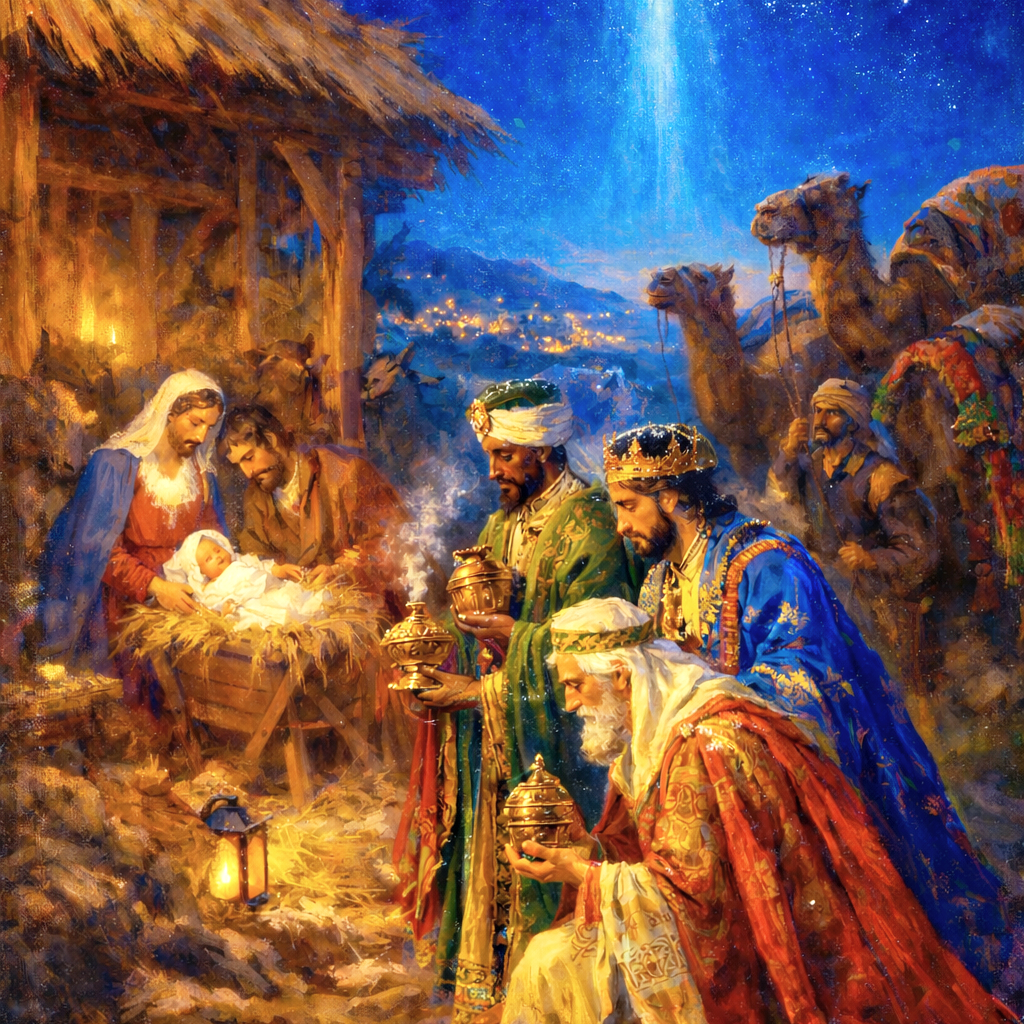
As a child, Epiphany felt like pure awe. In my imagination it always arrived on the darkest night—deep blue sky, sharp cold air, and then sudden brilliance: the Magi moving like royalty through the shadows. Their colors were vivid, almost defiant, against the quieter, humbler scenes we usually pictured at Christmas—the stable, the manger, the worn wood and straw. The Magi came with camels, with mystery, with gifts. They brought something extra to the Nativity story—something that made it feel larger than Bethlehem, as if the whole world had been invited. Even the song We Three Kings sounded louder than the rest—bold and regal, a child’s cue that something important was happening. Wake up. Here we go.
But as an adult, I find my understanding shifting. Where is the awe now? Where is the wonder I once carried so easily?
Epiphany arrives at an odd moment in the secular calendar. Christmas decorations are coming down. The world is already packing away the glow. (I stubbornly keep the Nativity up a little longer—I want the Magi to have their due.) We move straight into New Year’s resolutions. We return to work. We send the kids back to school. Sports practices and activities reclaim the family center. And all of it pushes against the Church’s insistence that this is not the ending of Christmas, but the unveiling of it—the manifestation of Jesus Christ, the Light revealed to the nations.
And how do we often celebrate that revelation? By putting everything away.
We tuck the holy story back into storage and replace it with self-improvement plans that collide almost immediately with the demands of work, school, schedules, fatigue. Then, before we know it, we’re back where we started—tired, distracted, and living as if the Light were an afterthought.
The Magi didn’t simply set goals. They moved. They acted. But they did not wander blindly. They didn’t stumble around in the dark the way we often do. They followed the light. They sought it, trusted it, and let it draw them forward—step by step—until it led them to Christ.
And then, after they found Him, they went home by another way.
That detail matters. Encounter changes direction. Worship rearranges the path.
This year, I want my faith to look more like that.
Last year my father died. A best friend died shortly after. Three of my four children are now adults, mostly out of the house, finding their way in the world. I turn fifty this year. So much is shifting—so much is asking me to find a “new way.” I can feel the questions rising: Who is God calling me to be now? What must I release? What must I repair? What must I sacrifice? What must I begin again with courage?
Epiphany reminds me that the Christian life is not meant to be lived in circles, returning again and again to the same patterns because the world is loud and my will is weak. It is meant to be lived in response to a Light—Christ Himself—who reveals, who calls, who leads.
So I am trying to take action. Not in the spirit of perfection, but in the spirit of pilgrimage. To keep moving. To keep Christ at the center. To bring Him what I have—my gifts, my grief, my hopes, my ordinary days—and to ask Him to make something holy of it.
And like the Magi, to go home by another way. ——-Mary Burns 2026
—-
